
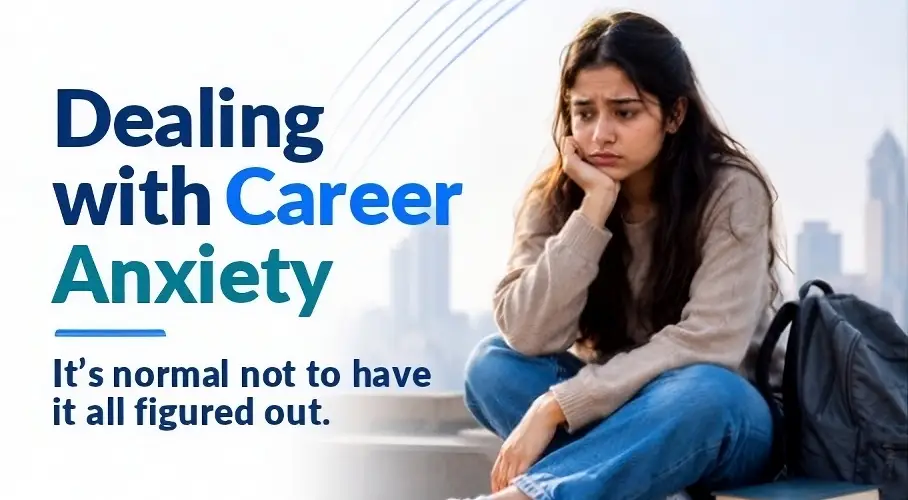
“What should I do after 12th?”
It sounds like a simple question, but for many students, it can feel like a huge burden.
One friend is preparing for entrance exams. Another has already chosen a professional course. Someone is talking about studying abroad, while someone else is learning a new skill and planning to start working.
And suddenly, you start wondering:
“Am I falling behind?”
“What if I choose the wrong career?”
“Will I get a good job?”
“What if I’m not good enough?”
If you have ever felt this way, remember one thing:
Career anxiety is normal. Your career is not a race.
After Class 12, students are often expected to make one decision that seems like it will define their entire future. But the truth is that careers are built step by step. Your first course, first skill, or first job does not necessarily decide your entire life.
What matters is understanding yourself, exploring opportunities and developing skills that can help you move forward.
Why Do Students Feel Career Anxiety?
Career anxiety can come from many directions.
1. Comparison with Friends
Social media and conversations with friends can make it look like everyone has a perfect plan.
But you usually see their result, not their confusion.
Someone may appear confident about their career while secretly being unsure too. Everyone has a different timeline.
2. Pressure from Family
Parents and relatives often want the best for students. They may suggest careers they believe are stable or successful.
But your interests, strengths and learning style also matter.
A successful career is not only about choosing a popular profession. It is about finding a direction where your skills + interest + opportunities can work together.
3. Fear of Choosing the Wrong Course
There are hundreds of courses available today—degree programmes, vocational courses, technical programmes, certifications and skill-based learning.
More choices can sometimes create more confusion.
Instead of asking:
“Which is the perfect course?”
Try asking:
“Which course can help me develop useful skills and move closer to the kind of work I want to explore?”
You Don’t Need to Know Everything at 17 or 18
It is completely okay if you don’t have your entire career mapped out.
Start with three questions:
What am I interested in?
What subjects, activities or topics make me curious?
What am I good at?
Communication, creativity, mathematics, technology, organisation, problem-solving, leadership or something else?
What skills are useful in the real world?
Look beyond marks and explore skills that employers and industries actually value.
Your answers may change over time—and that is okay.
Explore Before You Decide
Career exploration can make decision-making easier.
For example, a student interested in technology doesn’t have to immediately decide between becoming a software developer, data analyst, UI/UX designer or cybersecurity professional.
They can first explore introductory learning in areas such as:
- Computer & IT Skills
- Data Analytics
- Artificial Intelligence & Emerging Technology
- UI/UX Design
- Digital Marketing
- Communication & Soft Skills
- Vocational & Technical Skills
- Business & Entrepreneurship
Exploration gives you information. Information gives you confidence.
Build Skills Along With Your Education
A degree can provide academic knowledge, but practical skills can help you understand how that knowledge is used.
For students after Class 10 or 12, skill-based and vocational courses can be a valuable way to explore career options and develop practical abilities.
Depending on your interests, you can consider courses related to:
💻 Technology
Learn the basics of computers, programming, digital tools, data and emerging technologies.
🎨 Design
Explore UI/UX, graphic design and creative digital skills.
📱 Digital Marketing
Understand social media, content creation, branding, digital communication and online marketing.
📊 Business & Management
Develop skills related to entrepreneurship, business operations, communication and management.
🔧 Technical & Vocational Skills
Explore practical, industry-oriented learning that can help you understand specific career fields.
The goal is not to collect certificates.
The goal is to build useful skills.
A Simple Career Anxiety Plan
When you feel overwhelmed, don’t try to solve your entire future in one day.
Try this simple approach:
Step 1 – Understand Yourself
Identify your interests, strengths and areas you want to improve.
Step 2 – Explore Careers
Research different career options instead of focusing on only one.
Step 3 – Explore Courses
Compare degree, vocational, technical and skill-based learning options.
Step 4 – Learn One New Skill
Start with a beginner-friendly course related to your interest.
Step 5 – Get Practical Exposure
Work on small projects, activities or real-world assignments.
Step 6 – Review Your Direction
After gaining some exposure, ask yourself:
“Do I enjoy this? Do I want to learn more?”
If the answer is yes, continue. If not, explore another direction.
Changing your direction is not failure. It is part of discovering what works for you.
Your Career Is a Journey, Not a Single Decision
You don’t need to have all the answers today.
You need a starting point.
At Phir Shiksha, the focus is on helping learners explore vocational education, technical learning and skill-oriented courses after Class 10 and 12.
Instead of being trapped by the question “What should I become?”, start asking:
“What can I learn today that will help me become better tomorrow?”
Your career does not need to be perfectly planned.
It needs to be thoughtfully explored.
- So take a breath.
- Learn something new.
- Explore different possibilities.
- Build your skills.
- Ask questions.
- And give yourself permission to grow.
You are not late. You are learning.
Phir Shiksha – Explore. Learn. Build Your Future.